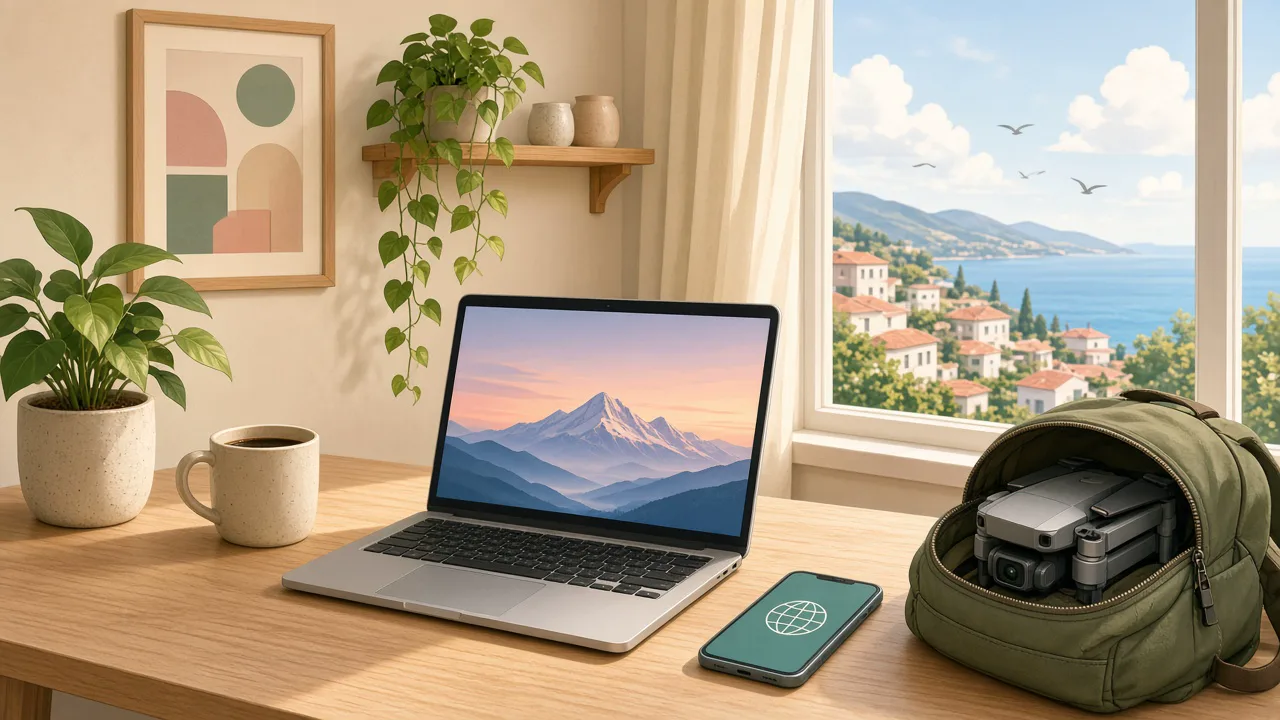
Most nomad kits are already decided before anyone mentions a drone. The laptop is non-negotiable. The eSIM is how you land and keep working. A charger brick, maybe a small power station if you work away from cafes — we have written that outdoor-office power story before. Then someone asks whether a foldable under-249g aircraft is worth the last zipper.
This is not a hardware lab review, and dyordo is not becoming a drone site. It is a travel-creator packing question: when does aerial B-roll earn a slot next to the laptop, and when should you leave it at home? Camera-by-camera bake-offs belong on a device-focused site. The useful decision here is workflow.
The kit you already carry
A typical remote week is a laptop, a phone with an eSIM, one multi-port charger, and maybe a compact mic. Remote-work software solves the office. It does not solve the “every frame looks like a café table” problem. The only honest reason to add a travel drone is establishing shots — coast, hillside town, trailhead — so the week’s laptop footage has a place.
A foldable under-249g aircraft is the lightest way to buy that shot. It is still a second system: batteries, a controller, props, and a practice habit. If you will not fly it, it is packing foam.
Weight class is a travel filter, not a passport stamp
The 249g line exists because many aviation authorities treat sub-250g aircraft more gently for recreational flying — less paperwork than a heavier cine drone. Skyrover S1 is built for that class: foldable, takeoff weight designed to stay under 249g with battery, props, and a memory card.
Treat the marketing sentence as a starting filter, not a global permit.
- Recreational rules in the US and many EASA countries are simpler under 250g. Commercial work, client shoots, and some cities are a different stack.
- National parks, airports, downtown cores, and temporary event zones are often no-fly even if the aircraft is light.
- Some countries require visitor permits, local registration, or ban tourist drones outright.
- Weigh the actual aircraft before a trip. “Under 249g” is a class. Accessories, a different battery, or a stuck SD card do not get a vote from the scale.
If you cannot be bothered to check the local aviation app and the park rules the night before, skip the drone. The bag slot is cheaper empty than a confiscation story.
Packing: the drone is small; the system is not
The folded airframe is the easy part. What fights the backpack is the kit: padded sleeve (not against the laptop), controller (often bulkier than the aircraft), spare props, and one or two batteries — not a six-pack. Skip ND filters on the first trip.
Park it in a side pocket or front organizer. Keep a tiny takeoff list on your phone: compass, return-to-home altitude, and a glance at towers and birds.
Airline battery rules (the part security actually cares about)
This is the unglamorous checklist that decides whether the bag slot is viable.
- Spare lithium batteries go in carry-on, never checked luggage. That includes drone packs.
- S1-class packs are typically around 18–19Wh — well under the common 100Wh carry-on threshold. Confirm the Wh printed on your cells.
- Tape or cap the terminals. A spare rattling against keys is how people get pulled aside.
- Two spares is a comfortable default. A six-battery pouch is a different conversation.
- Expect inspection. Answer plainly: travel camera, spares in the cabin bag.
If the week is three connections and you already dread lithium questions, skip. The eSIM and laptop already occupy enough of the tray.
When Skyrover S1 is enough
S1 is the beginner-friendly Skyrover in the under-249g class: 4K video, a 3-axis gimbal, roughly 40 minutes of official hover/flight time in lab conditions, and one-tap travel modes. Real flights are shorter in wind. That is still enough for two or three establishing clips before you go back to the laptop.
Bring it when most of these are true:
- You publish travel or location-based creator work, not only Slack screenshots
- You will fly in open areas first — a beach, a hillside, a quiet field — not between balconies
- You can live with forward/downward sensing rather than a full 360° rig
- You would rather have one extra zipper than a second camera body
- You will actually practice: a calm hour on day one, not a cliff edge on day six
If you already know you need more sensing, HDR, or a screen-first controller as a daily driver, Skyrover’s higher kit exists. Most nomads should start with S1 or skip aerials entirely. That is the honest split.
See Skyrover S1 on the official siteWhen to skip it entirely
Leave it at home when any of these are true:
- Your “travel content” is cafés, coworking desks, and indoor product shots
- This month’s countries are strict about visitor drones, or you have not checked
- You will not spend an hour practicing in an empty field
- You already resent every extra 400 grams
- You need cinema low-light, heavy ND work, or a second operator — that is a production trip, not a nomad week
Skipping is a valid workflow. Plenty of strong travel writing never leaves ground level.
| Situation | Bag slot? | Why |
|---|---|---|
| Coast, hills, trail towns; you publish location B-roll | Usually yes | Establishing shots earn the zipper |
| Café / coworking month, indoor work | Skip | The laptop already is the kit |
| First drone, willing to practice in open space | S1 is enough | Weight class + foldable packing |
| Client cinema, night streets, dense cities | Skip or a different kit | Wrong job for a travel mini |
| Three tight connections, lithium fatigue | Skip this trip | Security cost beats the footage |
✓ Pros
- Foldable under-249g class often simplifies recreational paperwork (verify locally)
- One extra zipper can buy the establishing shot your phone cannot
- S1-class flight time is enough for a few clips, not a film unit
✗ Cons
- The controller and batteries are the real volume, not the folded frame
- Rules, parks, and airports vary; light weight is not a permit
- Unused, it is expensive packing foam
A light practice loop (so the bag slot is not a toy)
- Charge batteries the night before, not at the overlook.
- Fly first in an empty, legal, open area. Learn return-to-home before any coastline cliff.
- Capture two establishing moves: a slow rise off a path, a gentle orbit of a landmark you are allowed to film.
- Land, fold, back to the laptop. Edit the same day so you know whether the footage is even useful.
- Do not fly over people, roads, or wildlife for a thumbnail.
If that loop feels like a chore, you have your answer: skip.
Soft next step
If the zipper is worth it, start on the official Skyrover site with S1, not a heavier kit you will resent at the airport. Read the live specs, battery Wh, and local flying notes there. Prices and regional rules move; this page will not try to outrun them.
Browse Skyrover (S1 first)Do I need to register an under-249g travel drone?
Can I take Skyrover S1 batteries on a plane?
Is this a review of every travel drone?
Should every digital nomad buy one?
Bottom line
A foldable under-249g drone is optional infrastructure, like a travel tripod. It earns the bag slot when you will actually fly it in legal open space and you need a place-shot your phone cannot fake. For that job, S1 is enough for most nomads; a bigger aircraft is a different trip. For everyone else, keep the zipper for socks.